New — 2026

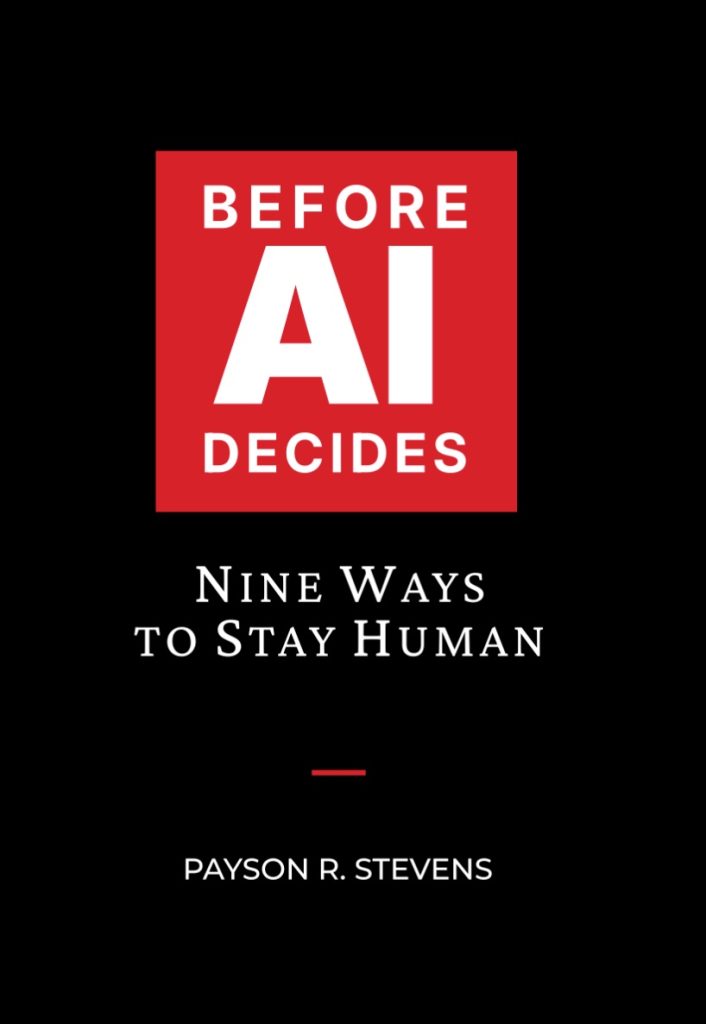
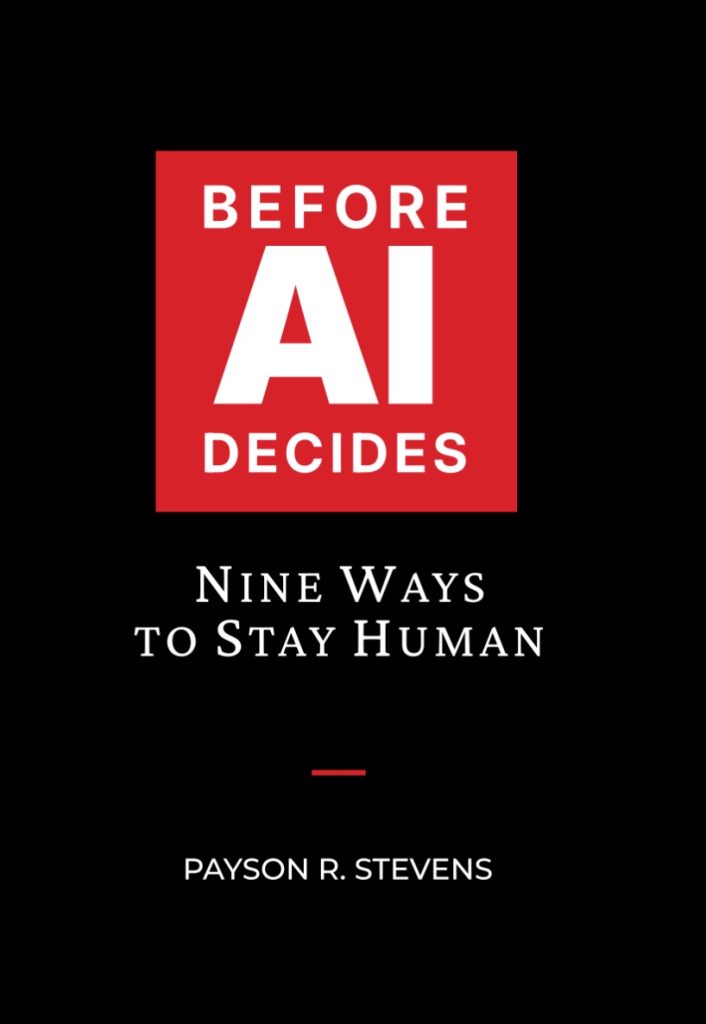
Before AI
Decides

Nine ways to stay human
while machines shape decisions.
Artificial intelligence already influences who gets hired, treated, approved, and seen.

80%

of Americans already interact with AI daily. Most don’t realize it

9

pillars that keep human judgment where it belongs

1

book that shows you exactly what to notice

Ten things happening right now

Ranked by urgency and real-world impact. Tap any item to see the full picture.

Expand all

01
AI Is Already Deciding, Not Just Assisting

In hiring, healthcare, credit, policing, education, and media, AI systems now make or shape outcomes before humans ever see the case.

GoodSpeed, scale, consistency
Not goodDecisions happen without consent, visibility, or appeal

If you do not know when AI is deciding, you cannot protect yourself.

02
Convenience Quietly Replaced Consent

AI entered daily life through helpful tools, not public debate. By the time people noticed consequences, the systems were already embedded.

GoodFriction disappeared
Not goodNo one agreed to trade judgment for efficiency

Defaults became decisions without permission.

03
Responsibility Has Been Diluted Across Systems

When harm occurs, no single person is accountable. Vendors blame clients. Clients blame tools. Tools blame data.

GoodInnovation moves fast
Not goodHarm becomes unfixable

If no one owns the decision, no one fixes the damage.

04
Explanations Are Disappearing

Many AI systems cannot explain their outputs, even to their creators. People receive outcomes without reasons.

GoodComplex patterns can outperform humans
Not goodUnexplained decisions undermine trust, rights, and due process

A decision you cannot question is not accountability.

05
Optimization Quietly Changes Values

AI systems optimize for metrics like engagement, efficiency, or risk reduction. Those goals shape outcomes, whether intended or not.

GoodMeasurable performance improves
Not goodHuman values get flattened into numbers

What you optimize for becomes what you value.

06
Mental Health Is Being Actively Shaped Key Issue

AI systems now influence attention, mood, belief, and behavior at scale. This hits hardest for children and teens.

GoodPersonalization can support learning and access
Not goodAttention capture harms development and agency

Minds are not test environments.

07
Creativity Is Being Treated as Free Raw Material

AI systems are trained on vast amounts of human work without permission or compensation.

GoodPowerful new tools emerge
Not goodCreators lose control, credit, and livelihood

Innovation that erases its sources is not sustainable.

08
Speed Is Outrunning Governance

AI systems are deployed faster than laws, norms, or oversight can respond. This is true at every level.

GoodRapid deployment solves problems quickly
Not goodHarm spreads before correction is possible

Fixing things after scale is often too late.

09
Children Are Becoming Unwitting Test Subjects Key Issue

AI tutors, filters, recommendation systems, and therapy tools increasingly interact with children without long-term study.

GoodAccess and personalization improve
Not goodDevelopmental consequences are unknown

Children cannot consent to hidden experiments.

10
The Future Is Being Set by Defaults, Not Deliberation

What we accept today becomes tomorrow's normal. Most AI systems shape behavior quietly, without public choice.

GoodProgress feels effortless
Not goodWe drift into futures we did not choose

The most dangerous decisions are the ones no one notices.

You do not need to understand how AI works.
You need to notice when judgment is being replaced.

That is what Before AI Decides is for.

The Answer

The Nine Pillars for Staying Human

A practical framework for life inside AI systems
Pillar 1

Seek the Truth

Why confidence is not accuracy

AI sounds certain. That is not the same as being right. Knowing the difference is the first skill.

Pillar 2

Show the Work

Why transparency enables trust
If you cannot see how a decision was made, you cannot challenge it. Transparency is not a bonus. It is a baseline.
Pillar 3

Own Your Self

Why agency must remain human
Your identity, your data, your choices. Agency is not just a concept. It is something that can be quietly taken.
Pillar 4

Let Humans Decide

Why judgment cannot be automated away
Healthcare. Justice. Employment. The decisions that shape lives still need a human in the room. With the authority to act.
Pillar 5

Pay for Human Work

Why extraction erodes culture
When AI uses human labor without credit or pay, culture shrinks. Writers, artists, workers built what AI consumes.
Pillar 6

Protect Minds

Why attention shapes wellbeing
Algorithms designed to hold attention do not care what that attention costs. Mental health is a design choice.
Pillar 7

Design for Fairness

Why bias scales with systems
One biased model, millions of wrong decisions. Fairness must be built in. Not hoped for after the fact.
Pillar 8

Fix What Breaks

Why confidence is not accuracy
Errors at scale are not accidents. They are systems failures. Accountability means someone answers when AI causes damage.
Pillar 9

Choose the Future

Why defaults should not decide for us
The future is not written. But if we stop paying attention, it gets written for us. By defaults we never chose.
These are not aspirations.They are requirements.

The Book

What this book does

Before AI Decides shows how decision-making drifted out of human hands. And where it can still be reclaimed.

It does not ask you to master AI. It asks you to notice when judgment is being replaced.

The goal is not resistance. The goal is responsibility.

How the book is built

Part I

The problem — how decisions left human hands without anyone noticing

Part II

The Nine Pillars — a framework for keeping judgment where it belongs

Part III

Two futures — what happens if we act, and what happens if we don’t
Parents Workers & Creators Anyone who uses apps People who care about fairness

What experts are saying

Vigilant human attention is essential. People are already being overridden by systems shaping decisions that matter.

Erik Viirre, MD, PhD

Director, Center for Human Imagination, UCSD
A clear-eyed wake-up call. Not doom. A case for guardrails that keep people in the loop.

Anne Leer

AI Industry Expert on Policy & Governance
A gift beyond measure.Seminal work on conscientiously incorporating AI into our lives.

Ken Druck, PhD

Best-Selling Author

AI now confronts us with autonomy at scale without visibility or reversal.That may be a point of no return.

Lee Stein

Entrepreneur / Inventor advancing responsible innovation
This book keeps the human capacity to ask “why” alive. Clear, grounded, and practical.

Jessica Seddon, Ph.D.

Senior Lecturer, Yale Jackson School of Global Affairs
A gift beyond measure.Seminal work on conscientiously incorporating AI into our lives.

Charles M. Levine

Former Vice President, Random House

Your Move

Judgment survives through use

Staying human is no longer automatic. It is a practice.
Without the Pillars
Decisions made for you. Errors no one owns. A future designed by defaults.
With the Pillars
Decisions made with you. Errors repaired. A future you actually chose.

The book ends with both futures written out. See where each one leads →

From Chapter One
“The doctor looked at the screen and said, ‘The system recommends.’ Not ‘I recommend.’ The shift had already happened. From judgment to process. From person to procedure. Most patients never noticed the difference.”
Continue reading →

Payson R. Stevens

Author & Environmental Communicator
Payson R. Stevens is an author and environmental communicator whose five-decade career includes pioneering digital work for NASA, NOAA, and the USGS. His award-winning project Arctic Data Interactive received a U.S. Presidential Design Award. His current work examines judgment and responsibility in the age of AI.

★ U.S. Presidential Design Award — Arctic Data Interactive

© 2026 Payson R. Stevens. All rights reserved.